21.2.07

Drawings by children in scene 4 of Ark

These drawings were done by Keziah or Isiss on the way back from Coney Island, shortly after shooting scene 4 of Ark (April, 2002).

shine beauful nice

"This is cool"
"Really cool"
"I knew" [what would be inside the box]


Then we did a puppet show with little people

20.2.07

Ark, revisited...

I ran across these notes I had made on the day we filmed the last scene of Ark, in April of 2002, out at Coney Island in the freezing cold, with Keziah, Isiss and Rodney, ages 7, 6 and 5.
I had asked the children, during our shoot: What could be inside the box?

- I don't think we should open it because someone might be looking for it now.
- Let's just open it; it's just a treasure.
- Maybe all the way when some Indians lived at the beach and they buried it in the sand and some pirates be looking for it! For 15 years. . .
- I think it's fairies or I think it's golden shiny rocks and golden shiny jewelry.
- I can't imagine what's in it--let's just open it!

And then they opened the box. See this portion of Ark on the Digital Story Workshop website.

8.2.07

Early Childhood: Listen to the Children Play*

Last week I attended the latest meeting of the New York Voices for Childhood, a group started by Deborah Meier in the Spring of 2006, as a reaction to the recent developments in "school readiness" as put forth by the national and local departments of education. Rather than test pre-kindergarten children to see if they are "ready for kindergarten," the professors and K-12 teachers who have been attending these meetings believe that educators should be supporting the youngest children as they play, not teaching them how to take standardized tests at age 4. This group, NY Voices for Childhood, in collaboration with the Alliance for Childhood, is developing "a campaign to restore creative play and hands-on learning to preschools and kindergartens." Their goals are as follows:
1. to develop and implement a public information, engagement, and advocacy campaign, with outreach to educators, parents, policymakers, and others concerned about the well-being of our nation's children.
2. to cultivate multi-faceted media coverage--including print, broadcast, and web-based--that focuses on the broader picture of childhood and the need for creative play and hands-on learning.
3. to realign the education and professional development of early childhood educators with the tenets of experiential learning.

It saddens me that it has come to this, that our supposedly modern society has allowed our educational system to turn into a bureaucracy that has abandoned what Dewey and the progressives taught. We are plummeting backward at a steady clip, such that if we can ever get out of this quicksand of assessment-based education, we will have to re-learn those long-lost innovative and creative teaching strategies that once promised to positively transform society through education. Digital Story Workshop is but one tiny tool that can help interested artists, teachers and citizens to counteract the stranglehold testing has on our schools and, by extension, the children we have the responsibility of raising.

*with apologies to Manuela Testolini Nelson's organization, which is working on a documentary called "In a Perfect World . . . Listen to the Children."

14.11.06

Treasures, continued. . .

Transcription of voiceover narration for Mystery Castle Project
(Each item is another child's voice. My questions are interspersed.)

• Maybe I would think that it’s called a treasure box. Because it looks like treasure, because when we put it somewhere, and it looked-ed like a treasure that nobody can find it there.
Whose treasure?
• Our treasure. Everybody’s treasure that you took, to that, to that, to there, and maybe they saw it and they was like, “that’s a treasure.”
What is a treasure?
• A treasure is when you find—when you, when you. . . when you want to go to it, and you open it, and it has stuff in it.
• A treasure if you, if you have a key, and you open it but squirrels don’t eat keys cause they use their own thing for their own house.
• They use their arms.
Why were you dressed in orange?
• Because Orange is a beautiful color. . . and we found a mysterical (sic) treasure.
What was the box like?
• (With great excitement on her face, whispering urgently): It had berries! And porcupines!
We love the box. We were the first ones to find it. Cause it was a treasure. When we left, he was crying…the box. Cause the box was our friend.

There may be many definitions for treasure, and certainly each of the children saw the box in their own unique way. But every child involved in this project perceived the box made of seeds and nuts to be something special. It was something that no one had ever seen before, an object that could help the squirrels and the other 'little ones,' a place that was mysterical and mysterious, a thing that was loved and treasured, by humans and animals alike.

These children's journey together into the world of the seed-box-treasure is something 'mysterical' in itself--it draws me in as I sit here editing it. I have found myself often shaking my head in disbelief at the artistry and poetry of the words the children put together. If you want to venture inside the minds of young children and their imaginative wanderings, as scarily brilliant and beautiful as they are, this might be a good place to start. Order the DVD
here.

12.11.06

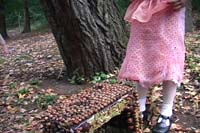
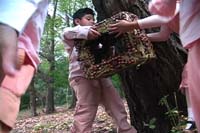
The following is spontaneous dialogue from the latest DSW project, in which four groups of 5-6 year olds played in the park and found a sculpture consisting of hundreds of seeds (acorns, maple seeds, sycamore, sweet gum, honey locust, horse chestnut) made, unbeknownst to them, by older children from their after school program.

Group 1
It’s something like a coconut!
It might be a squirrel house! You can’t go to this place! It might be a squirrel, and it will bite us!
I’m not scared…. (as he picks up the sculpture)
Ewww! Ewww! (two children squeal in alarm)
I saw a real nut, it’s a little baby one!
Oh, touch this! Touch this! It don’t itch, it don’t itch! I see a clue inside!
And this is stairs!

Group 2
I found something!
Oooh!
Look, that’s the same thing! (found sweet gum seed on ground like one on the sculpture)

Group 3
We found it—it’s a treasure!
What is in here? Oooh, it looks nice!
It looks famous!
It’s a treasure! Let’s bring it to our home! Let’s bring it to our mobile home!
Where’s our mobile home?
Right here, right there (puts object down in front of a tree).

I’m going on a piggy bank ride!
A what?
A piggy bank ride!
I give you the DESTINY! Of! The forest! I give you my own ___ of destiny! Today! We will bring a treasure to the King! I’m going to put a flower!

Group 4
Look what we found!
Nuts….
Freaky….
I think that we should put it in there…
I see a hole over there…
Careful with the pointy stuff!

Notes I wrote as I edited Group 3’s scene:
When all of the children see it, their eyes get bigger. They stop in their tracks. They look around for someone to whom they can share this secret finding. How quick some of the children are to label this strange object a “treasure.” What is that readiness, the willingness for the object to be special, to be so unique and wonderful as to be worthy of the moniker “Treasure”? They have no qualms, they waste no time in whispering, saying, shouting the word. They do not wonder if it is a treasure; they merely speak the word, they give the object its rightful name: treasure.

Others do not speak a word. They merely look at the thing and touch it warily and look around incredulously at their companions. This is quite strange, their eyes say to each other. One among them may move to pick it up, but others in the group are convinced that they should oppose this decision and shout at that person or even kick the sculpture. What is certain is that this object is not anything the children know about. They will soon figure out among themselves what it is and what should be done with it. They will create its mythology.

Two weeks after the play/videotaping in the park, I showed the children the video of their play/discoveries. Each group viewed their own scenes, only, such that they didn’t know what the other groups did with the sculpture or thought it was. I will write more soon about the voiceover narration they provided, as they were watching.

11.11.06

Mystery Castle with a Lot of Treasures

On Wednesday of this coming week, the latest DSW video will be screened, at Cypress Hills East New York Beacon Afterschool Program, in Brooklyn. The video is the product of the Brooklyn Arts Council Community Arts Grant. The Arts Council gave the project one of the two Individual Artist Tier prizes that it awards every year, so that I could produce a work of art that involved members of the community.

These stills of the project say it all:


Special thanks to Sean Eno, who was videographer for this project. What lovely pictures he makes.

Please join the children for the screening of their video:
PS 89/IS 302 Auditorium
350 Linwood Street (at Atlantic)
(C train to Shepherd; J train to Cleveland)
Wednesday, November 15, 2006
5pm