21.1.08

Listening to the Children's Voices

On Friday, January 18, I presented my work for the New York Coalition for Play, a group of colleagues in the NYC area who are working to improve children's opportunities for play. Some of the entities represented were: The Alliance for Childhood, Children’s Environments Research Group at CUNY, NYC Early Childhood PD Institute, the Rockwell Group (creators of Imagination Playground) the NYC Parks Department, the Child Development Institute at Sarah Lawrence College, the Brooklyn Children's Museum, the Children's Museum of Manhattan, the UFT, NYC DOE teachers, and independent education scholars and consultants.

I shared clips of videos I had made with children in Brooklyn and beyond, from 2001 (Sophie in the Trees) to the present (Red Hook/PS 27), and gave special emphasis to the poetic language I have experienced children using in their voiceover narrations of the videos. Some examples:
She's looking at something that we can't see. (Sophie in the Trees)
The seeds will be able to grow inside the dolls, and maybe they will pop up as a little kind of food. (Ark)
A grass pulled me down, all the way down, all the way to outer space. (Mystery Castle)
It's raining because the leaf is putting up to the sky. It's raining. (PS 27)
I think it was a camera but nobody was watching. Or maybe somebody put a camera inside a seed to look at us. (Mysteries in the Woods, work-in-progress)
I remarked about the sense of mystery that has permeated this work, particularly as heard in the children's voices themselves, as they have told the stories of their video-plays over the past seven years. Regardless of the setting or project, each group of children I have worked with has been captivated with the idea that something mysterious may be going on outside while they are playing, or even the idea that they might have found an actual treasure, hidden in the ground, behind a bush, or in a hole in a tree. Young children are completely tuned in to the metaphysical possibilities inherent in the simplest act of play. In that sense, they have much to teach adults about awareness of the spiritual realm of everyday life. I hope that at the least, my videos may help young children to access this other side of life, especially if they are not given other opportunities to do so, in school or at home.

The group also heard from Penny Wilson, esteemed Play Worker from the Play Association Tower Hamlets in London, who gave a heartfelt talk about the power of play to open up children's hearts and minds. The Alliance for Childhood is sponsoring her current tour of the U.S., which will include stops in MD, D.C., IL, MI, and CA, where she will facilitate Americans studying Play Work as practiced by Penny and her colleagues in the UK, in Adventure Playgrounds and other conducive play environments. Penny spoke so eloquently about the depth of meaning inherent in children's play. Educators in the U.S. have much to learn from her.

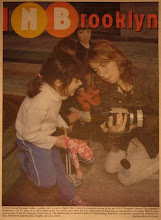
Finally we were enlightened by Richard Lewis, founding director of the Touchstone Center in NYC, who, there in the basement of the NYC Parks Rec Center on 25th Street, guided us in making "snow"! If anyone could remind adults about the power of the human imagination, it would be Richard. I have attended wonderful workshopsthat he has given surrounding the theme of the poetry of childhood at Henry Street and other venues around the city, but it had been a few years since I had seen him at work. Richard truly gets at the heart of the matter of the life of the child as seen through the lens of imaginative play, both inside the mind and outside. He showed us a telescope made in a workshop with children (see image above), that could function as a viewfinder for children's thoughts about play. When asked to look through their newly-made "telescopes" and to see and describe Play, here is what two children said:
The universe is like fireworks.
Things are always burning up.
The universe started by somebody playing. (Anoah)
I feel very good.
I feel so good when I play.
I catch my moment.
(Cristol)
Richard did such a beautiful job of making the imagination more real to all of us.

9.1.08

Ark at MCV/NYC

Ark, our 15 minute video from 2002 (about which I wrote my Ed.M. thesis), featuring four family groups of children from Brooklyn, in a mysteriously linked story about dolls, seeds and a box, has been installed for the past month, with the dolls, box and all eight costumes, at Artspace MCV/NYC in Brooklyn. We were thrilled to be part of the show "Risus," which benefited Toys for Tots, and to meet the artists/curators behind MCV, who were gracious enough to build out a beautiful corner of the gallery just for Ark. Thank you Jason, Sean and Lauren.

23.8.07

Matches Struck Unexpectedly in the Dark

Imaginative Education: Provoking Excellence Across the Curriculum Presented by the
Conference Presentation Abstract: In this workshop, Kristin Eno will provide a multimedia presentation including portions of several of the videos she has made with children since 2001. She will discuss and invite dialogue surrounding these issues in relation to making videos about children’s play: adult play-facilitation and how it helps children access their zones of proximal development; intellectual empowerment and growth through spontaneous storytelling; the poetic voice of children’s voiceover narrations; the relevance of playing, teaching and learning in natural outdoor settings; the great potential of more artistic, poetic children’s media; the viability of video-stories as teaching strategies for a range of curricular goals; the role of video as connector of diverse populations of children throughout the world; and the accessibility of digital video technology to teachers.

This conference was a wonderful opportunity to connect with teachers and professors of education across the world. I was most honored to present my work when Vivian Paley was in the audience. I have been admiring her work as a pioneer of storytelling/story-acting in the classroom ever since I first discovered her books in my elementary education classes at Dartmouth College. Vivian's response to my presentation was that the videos had captured "the authentic voice" of children's play. That sort of stamp of approval is something I do not take lightly. If anyone could make sense of the beauty and profundity of life as seen through the eyes of a child, it would be Vivian, who in her eloquent Keynote address, reminded us that our relationship with children is one that encircles the very mystery of the meaning of life itself. She invoked Virginia Woolf's words in To the Lighthouse: "What is the meaning of life? . . . The great revelation perhaps never did come. Instead there were little daily miracles, illuminations, matches struck unexpectedly in the dark; here was one...Mrs. Ramsay saying, 'Life stand still here.'" By calling up the words of this book I have so loved through the years, and applying Woolf's words to the context of young children's play, Vivian herself struck a match unexpectedly in the dark, and made life stand still. As Resa Matlock of the Childcare Collection at Ball State U. commented later at the conference, there is something about Vivian's voice that somehow helps us see what children are capable of teaching us, in a way that so few can. She is the rare teacher-thinker-writer-poet-friend to children. There should be many more of her kind in the world. We can try to do her legacy justice by taking her words to heart: "Just a few moments of spontaneous drama tell so much. Their storymaking spirals in pursuit of ideas, and in the midst of chaos, there is shape: life stands still here, the children are telling us...Watching children play invites philosophical discourse. Why do children do this, if not to prove the very necessity of their existence? They solve one problem and create another situation. The have a reason to exist, and it is to be with others, to prove that they are necessary to each other. They keep telling a story over and over as if to understand it. The child practices her thoughts, listens to her thoughts, so that she will understand her thoughts better. She will practice, practice, practice. We who spend our lives with children are surely trying to erect a listening community. The children will show us how it is done, if we give them the time."

Also at the conference I was pleased to see Beth Ferholt present her dissertation work towards a PhD in the UCSD Communication Dept., done in collaboration with a K-1 grade class on a military base Southern California. She and colleagues at USCD and universities in Finland (Pentti Hakkarainen, U. of Oulu) and Japan have been studying “Playworlds," a term that describes full engagement in imaginative play by both children and adults, and stems from Vygotsy's analysis of creativity and imagination, by way of Gunilla Lindqvist's work (The Aesthetics of Play: A Didactic Study of Play and Culture in Preschools, 1995). Beth shared her play world project based on The Lion, the Witch and the Wardrobe, including video clips that documented Beth and her colleagues' costumed interaction, in character, with the entire class, over the course of a year. As the adults played with the children, creating variations of the original book by C.S. Lewis, they developed an ongoing cross-generational spontaneous interactive story. As Beth was narrating through the video of the children and adults enacting the story, in full costume, with elaborate props that took up major portions of the classroom, I had the distinct feeling that this work was something truly special. The adults had made a huge effort to not only put on a show for the children, but to invite them into the show, so that they could all live and breathe the story. This effort was obviously not lost on the children, who could be seen to be experiencing the deepest, most profound joy at the progression of their play, which culminated in the whole group chanting "party, party!!", at the moment when the faun, Mr. Tumnus, was freed from the White Witch. Seeing the children's otherworldly happiness on the video footage was worth more than any words could say. It reiterated to me that the video medium is so powerful for us as adults, as we peer into the world of children's play and attempt to understand it.

7.7.07

DSW at the ICAF World Children's Festival

On June 24, Digital Story Workshop made four imaginative videos with small groups of young children on the Mall in D.C. for the 2007 World Children's Festival, hosted by the International Children's Art Foundation. This event brought hundreds of children to D.C. from all over the country and the world, and thousands of children with their parents from the surrounding area.

See the videos here. Here are stills from our play with four groups of 4-10 year-old children from all over the world:

Sean did the camera work, and then we edited with the children on-site, under a tent, immediately following our twenty minute play/videotaping sessions.

This was the first time that we worked with children to edit their own videos. Children as young as 4 were invited to see their play footage and interact with us as we edited in iMovie on a Mac laptop; 8-12 year olds participated in the editing process and learned the software with amazing speed. One young collaborator, Jonathan, 8, from Chicago, simply took off, editing quickly and intelligently, moving the mouse around to drag and drop scenes from one place to another in the timeline, to move scenes to the end of the video for a "Behind the Scenes/Making Of" segment. This prompted a whole new consideration of the role of editing in Digital Story Workshop projects. Could we figure out a way to use the editing activity in first and second grade classrooms, whether to teach story sequencing in literacy lessons or simply to teach technology education? I can only imagine how skilled Jonathan and others of his age could become at this task, if given the opportunity to edit video once every day, for fifteen minutes. Would any school in this country offer that as an option for him? Should it?

The other exciting element of this project was the spontaneity of the groups, from the four-year-old girls in the first group that included a child from Turkey and another from China by way of Virginia--the little English that the girls both knew provided a few words for them to say to each other, but for the most part, the play happened silently, with many facial expressions and a lot of body language (see "See Me Play")....to the mixed-age group of five 6-11-year-olds, from all over the world, the older of whom took roles as directors/documentors/prop assistants. The collaboration of this group of four, some of whom had only met moments before, was exciting. The improv team took their places, played their roles, had a cathartic experience, and life rolled on. The joyous result was "Superhero versus the Villain:" take a look at the fun these kids had! Since they were able to see their play on the computer screen shortly after they did it, and manipulate their actions within a storyline that they were developing together as they went along, even after the play itself, the learning experience was very tangible, and most of all, became like play.

25.5.07

Kindred Spirits Grow in Tulsa

My friend and colleague Heather Oakley's dream has come true: Global Gardens, an educational garden project for children in Tulsa, OK, is up and running! Through her garden workshops at Eugene Field Elementary School, Heather has combined her love for children from all over the world with her care for the earth, infusing her work with characteristic joy, hope and wisdom. The creation of a community garden with 31 student, family, and teacher garden plots (each with a theme, from "Oklahoma" to "Literary" to "Berry" Garden!) is providing a wonderful forum for members of the school and local community to learn about each other and the earth in a cross-disciplinary way, with science and peace education constantly interacting and informing one another. Heather's amazing method of gardening and teaching reveals to students and friends that physical, tangible growth is a vibrant manifestation of the growth of the soul. She is offering to the children a bridge from inside to outside, a solid link between their learning and their real lives. The centrality of documentation and blogging to the project provides yet another bridge--from the Eugene Field and Tulsa communities, to the world around them. I am looking forward to inviting children in NYC to dialogue with the Global Gardeners...

Global Gardens is a nonprofit, educational organization that provides schools and neighborhoods the resources that they need to incorporate educational, multi-disciplinary, science-based gardens into their curriculum and community. Global Gardens' primary goal is to establish student-centered garden spaces, where students and their families have ownership of the implementation, progress, maintenance, and activities of the garden. Global Gardens believes that these experiences encourage personal growth and lead to individuals becoming empowered to live healthier lives and become agents of change in their communities.

10.5.07

Bringing the Outside In

Two weekends ago, starting on a farm in western MA and ending up in Cambridge at Lesley University, I did video documentation for a wonderful Reggio Emilia Institute led by Dave Kelly of Grand Rapids Child Discovery Center, Cathy Topal of Smith College, Brigid McGinn of Pratt Institute, and Lella Gandini, U.S. Liaison for the Dissemination of the Reggio Emilia Approach. I am grateful to Kristina Lamour of the Art Institute of Boston and Brigid for inviting me to document this weekend full of beauty.

This three day experience was an amazing combination of a beautiful misty morning by the stream, summer camp, a personal hike through the woods, a journey into the minds of young children, and a collective, organic process of artmaking in reference to natural materials. The collective unconscious was truly at work, as pre-school teachers from all over the United States were invited outside to make sculptures that had a relationship with the land, and inside to manipulate clay such that its shape would echo seedpods, shells and branches. I felt that through the video camera lens, I was seeing my own artistic dreams played out by many hands. It was beautiful to see so many teachers be artists; and to think that this was all done in the service of becoming more attuned to the lives, thoughts, dreams and learning styles of 2-5 year olds. . . and on up through 5th grade and beyond, was truly life-affirming.

This event also called to mind the book I have been reading, Last Child in the Woods, by Richard Louv. The Children & Nature Network has many resources regarding the issue of children's outdoor play, and the more I think and read about it, the more I realize that outdoor play is the primary type of play I am advocating for, through the Digital Story Workshop videos. Children need to have freeing, beautiful experiences living and learning outside of school walls, far out in the meadows, forests, gardens, creekbeds, beaches, and mountains. We educators who are aware of the potential of outdoor adventures and projects to improve upon the life of the mind and spirit must be sure to provide such opportunities for the children around us.

8.5.07

The Imagination is a Very Powerful Thing

Last week, my friend Kathy's son, Milo, 9, watched Ark for the first time, and he made these effortlessly profound statements and descriptions:
Are they looking for the sea or what? Are they looking for a map of the sea?
• It's like a scavenger hunt.
• I guess they're using their imagination. The imagination is a very powerful thing.
• Oh look, it comes back to the beach; I always thought that would happen. It could go to all these places--to China!
[The narrator of the last scene says "cause if you don't tell a dream, it might come true. I knew that it was gonna come true."] Sometimes the universe speaks to you in dreams. The universe spoke to her.
• It was hard to open. . . probably because it was very, very old.
• They kept on adding dolls. . . through generations.
• The universe is very strong to that family.
• The dream was completely true about everything. Every single thing.
[The children put the box in the ocean]. Just as it has been, for generations and generations.
The contemplative Ark seems to have held the gaze of this thoughtful child who I thought was at the higher end of the age spectrum. Turns out that Kids First! Film Festival's child jury named Ark an official selection this year, and the festival labelled it appropriate for a 5-12 year old audience. That was a jump into the older regions of childhood, for Ark, but after hearing Milo's fascinating commentary, I agree that the 9-12 year-old set should definitely see it.

Notice that above, in Milo's drawing of the lid from the box, which the children discover and interact with throughout the story, he includes a representation of the photograph that is part of the inside of the lid of the box, so it's a drawing of a photograph, but not only that: Milo has drawn the box itself into that photograph. Once he told me that, I pulled out the real box itself and showed it to him, and he checked to see if the box was there in the photograph, inside the box lid. It was not. But shouldn't it have been?

Here are two more works of art Milo made that day, "Deep Space" and "Abstract":